Home Improvement & Home Services Marketing: Where Direct Mail Fits in a Modern Mix
Home improvement marketing has plenty of channels and little certainty about which ones pay. Google keeps changing how local ads work, lead marketplaces can sell the same homeowner to several companies, and every agency says its channel is the one you need. This guide lays out the full mix for HVAC, plumbing, roofing, lawn care, and pest control companies: what each channel does well, how you pay for it (without made-up price tags), and how to measure it.
We’re a direct mail company, so we’ll say up front where mail fits and where it doesn’t. Mail won’t replace being found on Google, but it does reach places search can’t.
Definitions
– Home services marketing: Marketing for companies that work at a customer’s home: HVAC, plumbing, roofing, lawn care and landscaping, pest control, and remodeling.
– Rented vs. owned channels: Rented channels (ads, lead marketplaces) stop producing when you stop paying. Owned channels (your customer list, reviews, rankings in Google’s free results, referral relationships) keep producing.
– Pay-per-lead: A pricing model where you pay when a customer contacts you, not when they click.
– CRM: Customer relationship management software, where you keep customer records and job history. Field-service software (for scheduling and dispatch) often does the same job.
– Matchback: Comparing a list of mailed addresses against booked jobs to see which customers received mail before buying.
What is home services marketing?
Home services marketing is how a company that works in customers’ homes gets found, chosen, and called back. It covers channels that catch people who are already looking (search, ads, lead marketplaces) and channels that create or keep demand (direct mail, email, referrals). The goal is booked jobs and repeat customers at a cost the business can sustain.
What sets home services apart is that you sell to a specific address in a specific service area, demand swings with weather and seasons, and the most valuable customers come back. Your marketing should reflect all three.
Which marketing channels work best for home service companies?
The channels that work best for most home service companies are a Google Business Profile with steady reviews, local SEO, pay-per-lead or paid search ads for urgent jobs, and owned channels (email, text messages where you have permission, and direct mail) to past customers and target neighborhoods. Which one gets the most budget depends on your trade and how urgent its jobs are.
Google Business Profile and reviews. Your Google Business Profile is the free listing that shows your company on Google Maps. For urgent jobs, the map results are often a homeowner’s first stop. Accurate hours, categories, photos, and a steady stream of recent reviews are the foundation everything else rests on.
Local SEO. SEO (search engine optimization) is the work that helps your website show up in Google’s free results. For local companies, that means service pages and service-area pages that answer real customer questions. They take months to rank but keep producing leads without per-click costs.
Local Services Ads and pay-per-lead. Google’s Local Services Ads charge per valid lead, with a weekly budget and bidding controls (Google Local Services Help). Google is now moving these advertisers to its Performance Max campaigns with pay-per-lead goals (Google Ads Help), so the setup is changing.
Paid search (PPC). Search ads you pay for by the click (PPC stands for pay-per-click). Fast and controllable, but you compete in an auction with every other company bidding on the same search terms.
Lead marketplaces. Third-party sites that sell homeowner requests. Quick volume, but the same lead may go to several companies, and you build nothing you keep.
Referrals and partnerships. Past customers, realtors, home inspectors, property managers, and general contractors. Often the best leads, but hard to grow on demand.
Email and text messages. Cheap ways to reach existing customers. They depend on having current contact info and, for texts, written permission.
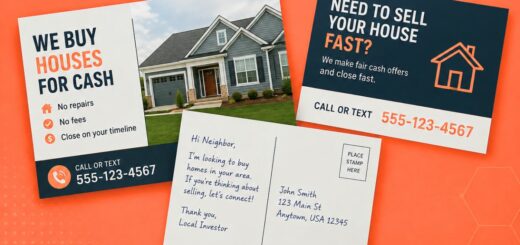
Direct mail. Printed pieces sent to specific addresses: past customers, neighbors of recent jobs, new homeowners, and targeted lists in your service area.
How does direct mail compare to Google Ads and LSAs for home services?
Google Ads and Local Services Ads (LSAs) reach people who are already searching, and you compete with other bidders for each click or lead. Direct mail reaches a specific address whether or not that household is searching, with no auction. Ads catch people who already need you. Mail is better at reaching chosen households before the need comes up and at bringing past customers back.
| Channel | Reach | Targeting | How you pay | How to track it |
|---|---|---|---|---|
| Google Business Profile / SEO | People searching locally | Search terms, location | Time and content cost; no per-click fee | Profile calls, form fills, leads by page |
| Local Services Ads / pay-per-lead | People searching for your service | Service type, service area | Per valid lead | Lead inbox, charged leads matched to jobs |
| Paid search (PPC) | People searching | Search terms, location, schedule | Per click (auction) | Call tracking, conversion tracking |
| Lead marketplaces | Homeowners submitting requests | Service type, ZIP | Per lead, often shared | Lead source field matched to jobs |
| Email / text | Your existing contacts | Your customer data | Low per send | Clicks, replies, booked jobs |
| Direct mail (targeted list) | Specific households you choose | Address, radius, homeowner and property data, customer history | Per piece (print, postage, list) | Tracking numbers, QR codes, offer codes, matchback |
| Every Door Direct Mail (EDDM) | Every address on chosen carrier routes (USPS) | Route-level demographics | Per piece | Tracking numbers, codes |

Where does direct mail fit in a home improvement marketing mix?
In a home improvement marketing mix, direct mail fits best where you know exactly who you want to reach: past customers, neighbors of completed jobs, new homeowners, unsold estimates, and pre-season campaigns. It supports search rather than replacing it, and it does the work search can’t.
Five plays that work across trades:
- Past customers. Tune-up reminders, renewal letters, replacement offers, and win-backs. Customers who already know your work are the warmest audience you have.
- Neighbors of completed jobs. Homes near your installs, roofs, or treatments often have similar age, construction, and needs. Mailing them also tightens routes.
- New homeowners. People who just moved in don’t have an HVAC tech, plumber, pest company, or lawn service yet.
- Estimates that didn’t close. A letter recapping the options keeps you in the running while the homeowner decides.
- Pre-season sends. Furnace and AC tune-ups, spring lawn programs, fall rodent control, and winterization, timed to land just before demand rises.
Plays 1 and 4 start with something that happens in your records, which makes them good candidates for triggered mail: you connect your CRM once, choose the change (say, an estimate marked unsold) and the letter it sends, and adjust it whenever you like. We cover how that works below.
Trade guides
- Pest control: 12 strategies to win and keep recurring customers
- HVAC: 15 marketing ideas for every season
- Plumbing: Lead generation without overpaying for leads
How much should a home service company spend on marketing?
A home service company should set its marketing budget from what it can afford to pay for a customer, not from an industry percentage. Estimate what a customer is worth over time, decide the most you’ll pay to win one, multiply by the number of new customers you need, and add a separate budget for keeping customers.
A simple way to build it:
- Set the target. How many new customers (or agreements, or installs) do you need next year to hit revenue goals, including replacements for the customers you’ll lose?
- Find your ceiling. From your job data, estimate the profit a typical new customer brings over their time with you. Decide what share of that you’re willing to spend to win one.
- Multiply. Target customers × most you’ll pay per customer = budget for winning customers.
- Follow the evidence. Put money into channels based on their tracked cost per booked job, and hold back a small test budget for new channels.
- Fund retention separately. Renewals, reminders, and win-backs serve customers you already paid to win. Don’t let spending on new customers crowd them out.

How do you measure marketing across channels?
Measure every channel on cost per booked job and, where you can, what each customer is worth over time. That requires a source on every job record: a unique phone number or code per channel and campaign, a lead source field your customer service reps fill in, and matchback of mailed addresses to booked jobs. Without that, the last ad someone clicked gets the credit by default.
Direct mail can get too little credit, because a homeowner who keeps your postcard may later call the number on your truck or search your name instead of using the tracked number. Matchback fixes that by checking whether booked customers were on the mailing list.
How do you work with Open Letter Marketing?
Open Letter Marketing offers three ways to run home services direct mail, depending on how much you want to hand off:
- Managed campaigns. Our team handles strategy, choosing and sourcing the mailing list (including targeting by area and by distance from an address, plus property and homeowner data), copy and design, printing and mailing, A/B testing (mailing two versions to see which works better), and response tracking with dedicated call tracking phone numbers and QR codes.
- Self-serve ordering. If you already know what you want to mail, order postcards, letters, snap packs, self-mailers, Real Penned letters (written with real ink pens), and multi-touch campaigns online. Real Penned letters don’t carry QR codes or tracking.
- Open Letter Connect. Our online app, where you order mail yourself or connect your other software to request it. In the app, Radius Mail handles play 2: enter a job address, pick either the closest 10 to 100 homes or every home within a 1/4 mile to 1 mile radius, and order the mailing in a few clicks. We print and mail it. The nearby-home addresses are a list purchase, charged per address ($0.15 each on the Starter plan), on top of printing and postage. For plays 1 and 4, you can set Open Letter Connect to send a letter or postcard when a record you choose changes in your CRM. It connects directly to HubSpot (with a two-way sync that sends delivery updates back into HubSpot) and GoHighLevel. Other software can connect through Zapier, a tool that passes information between apps (Open Letter Connect offers 8 mail-sending actions there, and your other app supplies the signal through its own Zapier connection), or through the Open Letter Connect API and webhooks, which a developer can use to build a custom connection. Plans start with a free Starter plan; Growth is $99 a month, Professional is $199 a month, and Enterprise is priced by quote. Printing and postage are charged per piece.
FAQ
Is direct mail still worth it for home service companies?
It can be, when it’s aimed at households with a reason to buy and tracked to booked jobs. Untargeted, untracked mailings are where mail earns its bad reputation.
What’s the difference between home improvement marketing and home services marketing?
They overlap. Home improvement usually refers to projects like remodeling, roofing, and windows, while home services also includes recurring and repair work like HVAC, plumbing, pest control, and lawn care. The channels are largely the same; the timing and how often customers come back differ.
Should I use EDDM or a targeted mailing list?
EDDM goes to every address on the carrier routes you select, addressed to “Postal Customer” (USPS). A targeted list lets you choose homeowners, past customers, or homes near your jobs. Use EDDM for broad local awareness; use targeted lists when you know who you want.
What are good contractor marketing ideas on a tight budget?
Start with what you own: ask every customer for a review, follow up on unsold estimates, mail or email past customers before your busy season, and mail the neighbors of jobs you’ve just completed.
How long does it take to see results from direct mail?
Calls start once pieces land, but judge a campaign over a set window that matches how long your customers take to decide. Repeat mailings to the same audience matter more than any single one.
Book a home services direct mail strategy call
Talk with Open Letter Marketing. We’ll look at your trade, service area, customer list, and current channel mix, and tell you where direct mail should fit, which audiences to start with, and how we’ll track results. If mail isn’t the right next step, we’ll tell you.